Upton Sinclair is a writer on the periphery of the periphery for me: I read and was duly horrified by
in high school; was a socialist but a best-seller in his day. His ethos -- a didactic, flat-footed Dreiser approach to Social Problems, if such a grisly thing is possible -- keeps him from canonicity. Like Harriet Beecher Stowe, he wrote one book everyone remembers and which performed a great service, and was written as such; the good intentions shake like the branches of old elm trees.
Paul Thomas Anderson will never be associated with causes. To think of him performing a service (other than re-introducing the awesome
Philip Baker Hall to casting agents) is enough to make me spit out the ice cube I'm chewing on.
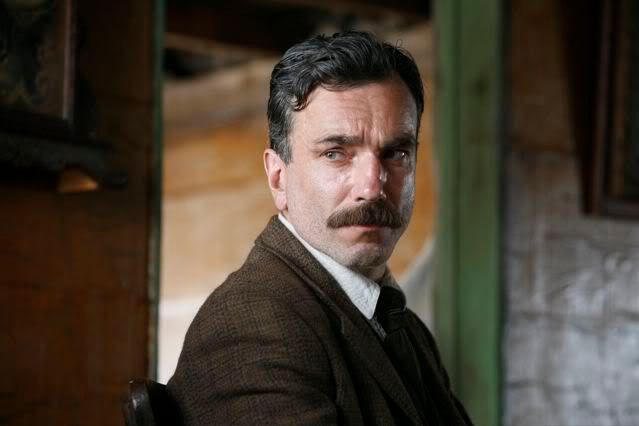
There Will Be Blood could use more didacticism. Conceived and shot like a the fever-dream of a doggedly sober man, it's so ascetic and apolitical that it could only have been made by a man who sees film as life. I haven't read
Oil! and I understand Anderson adapted only the first few chapters, but damned if I can't believe that Sinclair wrote his novel as if it was
The Wings of the Dove. His fluency with dollies and tracking shots belie the knock-kneed gait at which his films unfurl; he's the first director I know who's made three consecutive movies in which the events seem foreshortened yet attenuated. We come no closer to understanding Daniel Plainview's megalomania than his adopted son comes to thawing the monster's heart. Actually, Plainview isn't even that monstrous -- more like
weird, which can't be the point (again, I haven't read the novel). For all Daniel Day-Lewis' considerable finesse -- the ease with which he moves in character mitigates our distance from Plainview -- this final heir of the Method tradition, accepted without hesitation as one of the immortals (his last movie was another Oscar nomination-loaded Noble Effort) , inhabits a movie without the insectival greed of Plainview himself. It's as if Humphrey Bogart's Fred C. Dobbs from The
Treasure of the Sierra Madre were exiled in George Stevens'
Giant. Anderson aspires to Stevens' asexuality too, which is probably his idea of fairness: Stevens, recall, made oil derricks as sensuous as Elizabeth Taylor in her prime.
Also, I'm beginning to resent Anderson's politics of embarrassment. He can't resist filming a scene in which one or more characters perform an act of such abject mortification that it forces the audience to squirm
for the actor, not
with the character. Think of Philip Seymour Hoffman slapping his own head for making a pass at Mark Wahlberg in
Boogie Nights; or
all of William H. Macy's scenes, for that matter. Or Adam Sandler fighting with Hoffman (him again) in
Punch-Drunk Love. In a scene which may or may not be in the novel, Plainview and Paul Dano's preacher Eli confront one another for the last time. Since I don't get some of the bad press Dano's gotten -- his impassioned squeal and lack of girth work for the character -- I saw the possibilities latent in watching two such grossly mismatched opponents glower at each other (it helps that Day-Lewis has never looked so attractive, even when Plainview is disintegrating before us). I'm not sure what tone Anderson sought, but the scene has the intended effect: the audience, looking for a laugh, any laugh, guffaws at exactly the right moment after an act of rapid, predictable gruesomeness. Nothing is delivered, as Dylan once said. The scene floats, unmoored, with no relation to what we've learned; it's played and written as a sop to the audience. That's how it feels anyway.
It's weird reading these lazy reviews calling TWBB "epic" -- because it spans lots of years? it's shot in the desert? Anderson chose an "epic"-style font for his titles? This is a Noh drama, stylized yet minimalist. The audience can congratulate itself on having seen a "show," its prejudices about American history and the relationship between plutocracy and religious fundamentalism unchallenged; at least Richard Brooks' adaptation of
Elmer Gantry tried
. If ultimately it's not a very good movie, it's still a movie with a lot of very good things in it, helmed by a sensibility whose tics and obsessions are not getting more familiar as his resume lengthens.
 After listening to the copy of Vampire Weekend's debut EP that my friend Mike Powell had posted about 10 months ago (!), I thought it was okay: noted the sparkly guitars, the vocalist whose slight lisp and high pitch reminded of what's-his-name from Third Eye Blind, and, right, the Peter Gabriel reference. I got the album a few days ago and, although I should know better in this quick turnover listen-and-respond age, am baffled by the disjunction between its achievement and the opprobrium it's already generated ("I bet these guys read sheet music" is the stupidest criticism I've read in years). Vampire Weekend is as good as it's supposed to be and not one note more, an album by four smart guys tentative about everything -- women, Peter Gabriel, Benetton, college professors -- except their milieu, which you wouldn't know about if you didn't pay attention to their lyrics or the chatter of the gossiping classes*. If rock history teaches us anything, it's that a sense of geography may deepen into a sense of self: Vampire Weekend will figure out who they are when they've studied where they are. In a sense, I'm glad I'm not more enthusiastic about Vampire Weekend, and am doubly grateful that I don't live anywhere near New York.