A world I did not wish to enter
Took me and poised me on my centre,
Made me grimace, and foot, and prance,
As cats on hot bricks have to dance
Strange jigs to keep them from the floor,
Till they sink down and feel no more.
-- Thomas Hardy, "A Necessitarian's Epitaph"
Thursday, January 31, 2008

Now I've seen everything...
Armond White's complimentary review of the U2 concert documentary -- kind of. He's correctly notes the thrilling juxtaposition of surreality and documentary-style concert footage seen in the video of my favorite band:
U2 3D lacks the techno apotheosis you can imagine—the kind that might come from seeing a greater band in concert, as when dance-club imagery climaxes New Order’s "True Faith" music video. That wasn’t digital 3-D but ecstasy in analog.
Tuesday, January 29, 2008
I'm shocked that this article would miss the obvious explanation as to why Florida has so many seniors: the aging Cuban exile community. Naturally, it omits the most obvious explanation for why the U.S. was so generous towards my Cuban grandparents even though the Republican party they so heartily embrace would throw them over the side of a border wall if their feet weren't touching American soil: you get their votes by guaranteeing social services since they're not long for this world anyway. A deeply cynical move first adopted by LBJ's Democratic party and continued today, as shown by the pandering to Cuban talk radio demagoguery by every president of the post-Bay of Pigs era.
Monday, January 28, 2008
In defense of secularism
Responding to a Mitt "Mitt" Romney speech on his religious beliefs that, in the spin cycle of current pol drama, feels like ages ago (i.e. it was in December), Hendrik Hertzberg defines secularism in the best and simplest of terms:
No, you are wrong. Secularism is not a religion, any more than freedom of association is an association. Secularism is a political condition that permits a variety of religions and beliefs about religion to coexist peacefully. And the existence of God (or the divinity of Jesus) is not a fact to be acknowledged, it’s a belief to be protected, along with contrary beliefs or nonbeliefs.
Saturday, January 26, 2008
There will be non-epic
 Upton Sinclair is a writer on the periphery of the periphery for me: I read and was duly horrified by The Jungle in high school; was a socialist but a best-seller in his day. His ethos -- a didactic, flat-footed Dreiser approach to Social Problems, if such a grisly thing is possible -- keeps him from canonicity. Like Harriet Beecher Stowe, he wrote one book everyone remembers and which performed a great service, and was written as such; the good intentions shake like the branches of old elm trees.
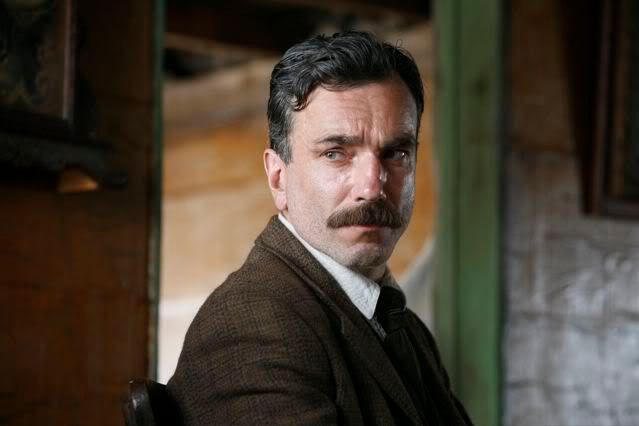
Paul Thomas Anderson will never be associated with causes. To think of him performing a service (other than re-introducing the awesome Philip Baker Hall to casting agents) is enough to make me spit out the ice cube I'm chewing on. There Will Be Blood could use more didacticism. Conceived and shot like a the fever-dream of a doggedly sober man, it's so ascetic and apolitical that it could only have been made by a man who sees film as life. I haven't read Oil! and I understand Anderson adapted only the first few chapters, but damned if I can't believe that Sinclair wrote his novel as if it was The Wings of the Dove. His fluency with dollies and tracking shots belie the knock-kneed gait at which his films unfurl; he's the first director I know who's made three consecutive movies in which the events seem foreshortened yet attenuated. We come no closer to understanding Daniel Plainview's megalomania than his adopted son comes to thawing the monster's heart. Actually, Plainview isn't even that monstrous -- more like weird, which can't be the point (again, I haven't read the novel). For all Daniel Day-Lewis' considerable finesse -- the ease with which he moves in character mitigates our distance from Plainview -- this final heir of the Method tradition, accepted without hesitation as one of the immortals (his last movie was another Oscar nomination-loaded Noble Effort) , inhabits a movie without the insectival greed of Plainview himself. It's as if Humphrey Bogart's Fred C. Dobbs from The Treasure of the Sierra Madre were exiled in George Stevens' Giant. Anderson aspires to Stevens' asexuality too, which is probably his idea of fairness: Stevens, recall, made oil derricks as sensuous as Elizabeth Taylor in her prime.
Also, I'm beginning to resent Anderson's politics of embarrassment. He can't resist filming a scene in which one or more characters perform an act of such abject mortification that it forces the audience to squirm for the actor, not with the character. Think of Philip Seymour Hoffman slapping his own head for making a pass at Mark Wahlberg in Boogie Nights; or all of William H. Macy's scenes, for that matter. Or Adam Sandler fighting with Hoffman (him again) in Punch-Drunk Love. In a scene which may or may not be in the novel, Plainview and Paul Dano's preacher Eli confront one another for the last time. Since I don't get some of the bad press Dano's gotten -- his impassioned squeal and lack of girth work for the character -- I saw the possibilities latent in watching two such grossly mismatched opponents glower at each other (it helps that Day-Lewis has never looked so attractive, even when Plainview is disintegrating before us). I'm not sure what tone Anderson sought, but the scene has the intended effect: the audience, looking for a laugh, any laugh, guffaws at exactly the right moment after an act of rapid, predictable gruesomeness. Nothing is delivered, as Dylan once said. The scene floats, unmoored, with no relation to what we've learned; it's played and written as a sop to the audience. That's how it feels anyway.
It's weird reading these lazy reviews calling TWBB "epic" -- because it spans lots of years? it's shot in the desert? Anderson chose an "epic"-style font for his titles? This is a Noh drama, stylized yet minimalist. The audience can congratulate itself on having seen a "show," its prejudices about American history and the relationship between plutocracy and religious fundamentalism unchallenged; at least Richard Brooks' adaptation of Elmer Gantry tried. If ultimately it's not a very good movie, it's still a movie with a lot of very good things in it, helmed by a sensibility whose tics and obsessions are not getting more familiar as his resume lengthens.
Thursday, January 24, 2008
No dangling conversations need apply
So that's where Art Garfunkel's been -- reading Lucretius, John Stuart Mill, Thomas Hardy, and, er, Fareed Zakaria. Thus proving that erstwhile partner Paul Simon's not the only rocker who can cite Wallace Stevens. Thanks to Andrew Sullivan for the tip.
Wednesday, January 23, 2008
Two obits -- by the NYT's A.O. Scott and Slate's Dana Stevens -- try to unearth the nature of Heath Ledger's promise. I prefer Stevens' because it concentrates on the problem that James Wolcott (no link, alas) addressed earlier in the decade: young actors have no clue how to move in character. Ledger certainly did, according to Stevens. Based on the decidedly lethargic, almost stunted poses of Ledger's Ennis Del Mar in Brokeback Mountain, I'd say that Ledger found the predictably Method way around the problem -- and somehow made it work. That he also mastered the traditional Douglas Fairbanks' kind of kineticism in the overlooked Casanova tells me all I need to know about his talent (speaking of which: it's as rote as you'd expect, but there's pleasure in that, and it was a pleasure even then to see Ledger relax, especially when cast against Jeremy Irons doing his damnedest Basil Rathbone impersonation and still managed to look wan). Who knows what his Joker might be like.
I like this bit of Stevens about Ledger's role in 2005's Lords of Dogtown, in which he plays a funny, grittier variant on the Patrick Swayze part in the awesome Point Break, Kathryn Bigelow's 1991 absurdity about surfer-bank robbers.
I like this bit of Stevens about Ledger's role in 2005's Lords of Dogtown, in which he plays a funny, grittier variant on the Patrick Swayze part in the awesome Point Break, Kathryn Bigelow's 1991 absurdity about surfer-bank robbers.
This scruffy, inspirational sports picture, a fictionalized remake of the skateboarding documentary Dogtown and Z-Boys, can barely contain Ledger's gonzo performance. He's fresh from Val Kilmer College, comically unhinged and unprecedentedly ugly. Late in the movie, after the Z-Boys skate their way to juicy endorsement deals and desert Skip one by one, he hurls surfboards off the roof of his store in a self-destructive rage, then sprawls on the roof's edge, guzzling from a bottle of whiskey while the crowd below gasps for fear he'll throw himself off.
Tuesday, January 22, 2008
Heath Ledger 1972-2008
 Ugh. He'll forever be remembered for Brokeback Mountain, deservedly, but his quiet performance in I'm Not There is the kind of unadorned excellent acting that never gets noticed, and suggests that he was only now discovering his power. He was very funny in Casanova and Lords of Dogtown.
Monday, January 21, 2008
 Many fools have tried to embrace the 19,000,000 neon bulb excess of Las Vegas and only gotten singed for their hubris (how many copies of U2's Pop have you counted at your local used CD store? has Brandon Flowers kept the mustache?). Occasionally someone gets it right -- in this case, Carl Wilson, whose entry in the 33 1/3 series on Celine Dion Let's Talk About Love: A Journey to the End of Taste proved excellent consumerist product on the airplane. I chewed on this aside on Sin City:
If there is a laboratory demonstration of the antagonism between economic and cultural capital, it is Las Vegas, a city of such pure commercialism that money is its entertainment, interrupted occasionally by a show...In this non-stop carnival of social inversion, only money is purely beautiful, in Kant's sense of being an end in itself. Vegas's fabled love of the ersatz, like its mini Eiffel Tower, is money giddily blaspheming culture's sacred icons. All of which, in the abstract, seems kind of healthy. But in the flesh it depressed the hell out of me.Well, yeah, it would, if you've never been to Walt Disney World, which, in addition to that Kantian sense in which the money-entertainment complex will consume itself after you've overdrawn your checking account buying a pair of Mouse ears, specficially targets the one segment of the population more uninhibited than the adult heterosexual male: the child. I wasn't very depressed: celebrating a bachelor party means you get the ride you pay for. But I must say, walking those labyrinthine subterranean corridors connecting mega-resort and casino four times a day, I never saw so many mirror-image representations of our group.
Thursday, January 17, 2008
Wednesday, January 16, 2008
A couple more reviews: Gore Vidal's last novel and the sequel to the best Theodore Roosevelt biography extant.
Subscribe to:
Posts (Atom)