Sunday, September 23, 2007

No promises

The second film in a row in which he had no hand in its writing, David Cronenberg's Eastern Promises is also the second consecutive film in which he reminds us that, before his art rep subsumed him, he was a skilled manipulator of batshit B-movie conventions. Since the charm of his work before The Dead Zone slipped past me, I don't have much invested in the Cronenberg mythos. Generally, the gorier the film the more moving it turns out to be (The Fly, Dead Ringers, A History of Violence), even though you shouldn't hold me to this adage either since it doesn't explain how dull existenZ was (Cronenberg's Lost Highway, i.e. a movie that became an unintentional, airless parody within seconds of watching it) and the hilarity of Naked Lunch, one of the only examples since Godard's mid-sixties run of a filmed precis -- in this case of the "unadaptable" Burroughs novel on which it's based. Droll, sad, and absurd *, Naked Lunch looks better every year, although it's impossible to remain objective: seeing it in January '92 in a multiplex with high school friends, surrounded by attentive bourgeois homosexuals, remains one of my seminal filmgoing experiences.

As a demonstration of Cronenberg's tonal control and ability to make a $25 million production look like a hundred million bucks (the restaurant scenes are plush enough to evoke Tolstoy by way of Joyce's "The Dead"), Eastern Promises surpasses A History of Violence. So does Viggo Mortensen's performance, which should be a textbook example of how to avoid Streepisms when learning an accent. Mortensen's become so good at settling into his physicality that it's easy to underestimate how transparent he makes thinking in character look (that he must project thought whilst shorn and slicked like H.R. Haldeman is an unabashed triumph). Too bad the film's underwritten: the resolution's botched, and Naomi Watts, speaking in her real voice for the first time in years, is uninspired. Cronenberg, uncharacterically, backs away from embracing Mortensen's potential for evil, which, the script notwithstanding, is defined not by the horrible things you do so much as the lack of deliberateness with which the person carries them out.

* "Droll, sad, and absurd" also describes Judy Davis' performance, one of the many good ones she gave between her terrific run between 1990-1993 before Woody Allen, punishing himself for writing her greatest part in Husbands & Wives, condemned her to harridan hell in two successive films which I won't mention here.

Friday, September 21, 2007

HI DERE I AM A SPRINGSTEEN COVER

In honor of the release of Springsteen's latest 4.5 star masterpiece Magic, here's a little treat. One of the more interesting covers:

Wednesday, September 19, 2007

Notes on Cruising

(The film, that is. Ask me about cruising on your own time.)

(1) Eric Henderson is right-on in admiring how the film's raunch sticks a lubed finger up the arse of the resigned gentility of, say, Brokeback Mountain. Of course director William Friedkin believes that, as he smugly reminds us in one of the DVD featurerettes, he couldn't make Cruising "in today's climate." For my generation the age demands domesticity, the hearth, and Rick Santorum's death by splooge. We get the movies we deserve, and, alas, the moistness of BBM occludes mainstream acceptance of something randier. I'm tempted to embrace the suspicion that Friedkin is more "sensitive" to gay sex than Ang Lee; sudden casual sex is brutish and stupid.

(2) For all the Crisco used in those Ramrod (or is it the Anvil?) scenes, why on earth didn't Friedkin use any on Al Pacino's hair? A dead ringer for a member of KISS circa Lick It Up, his "costume design" is by far the film's most repulsive element.

(3) Speaking of Pacino: for an actor infamous for charging into scenes like a hungry man in the Ponderosa buffet line, he is utterly colorless here. Look into his eyes – he's dead. While it's clear that the wages of undercover work compel him to have ever more frantic sex with Karen Allen (who's touching and smart in an non-existent role; the story of her career is being in the shadow of inferior men), he acts like his mind and body are somewhere else, and they're not considering the pleasures of fistfucking fantasias.

(4) If the Germs played in more gay clubs I might hit them more often.

(5) Karen Allen in leather jacket and kepis is hotter than Al Pacino.

(6) If you were getting advice about which color handkerchief to stick in your back left pocket, would you ask Powers Boothe?

Tuesday, September 18, 2007

Occasionally I remind myself that I was an English guy and fiction writer before a pop critic. With eMusic launching an audiobook section I'm hoping to write stuff like this more often.

Monday, September 17, 2007

Fifteen of my favorite songs of this not-yet-concluded year, in no order except which I'd rather hear right now.

Amerie - "Crush"
Ne-Yo - "Because of You"
The National - "Mistaken For Strangers"
Maroon 5 - "Makes Me Wonder"
Prince - "Chelsea Rodgers"
Justin Timberlake - "LoveStoned/I Think That She Knows"
Modest Mouse - "Dashboard"
The Killers - "Read My Mind (Pet Shop Boys Stars Are Blazing Mix)"
Ghostface feat. Amy Winehouse - "You Know I'm No Good"
Arctic Monkeys - "Fluorescent Adolescent"
Ciara - "Like A Boy"
M.I.A. - "Paper Planes"
Justice - "D.A.N.C.E."
Kanye West - "Stronger"
Spoon - "Don't You Evah"

Saturday, September 15, 2007

Shorter, vainer, louder, sadder

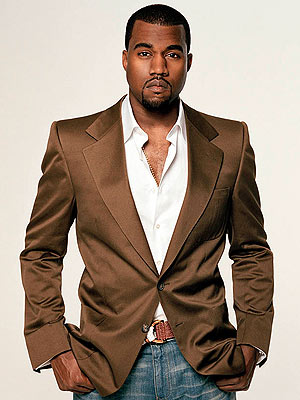
Like the Mick Jagger of Dirty Work or Richard Nixon on the day of his second inaugural, Kanye West envisions conspiracies between dumb-asses and "the establishment." Mobilizing resentment against those in power yet, of course, exempting themselves, these are men who had and have nothing to be glum about, yet their success felt compromised by paranoia, will to power, and (excluding Jagger) self-pity. I doubt if Kanye will ever top Graduation. As Anthony pointed out, it's pretty enjoyable for a "victory lap album," and the best proof that, unlike in most cases, a Kanye singles compilation would be disastrous. This guy has mastered record making; a sequence of singles would reveal his average rhyming, awkward flow, and unmitigated arrogance -- his jokes aren't funny enough to mitigate the arrogance. If it's too easy to imagine Norman Vincent Peale admirer Nixon mournfully scribbling "Everything I'm not made me everything I am" on one of his yellow pads, "Can't Tell Me Nothing" is scornful advice that the Jagger of "Hold Back" and "Dirty Work" might appreciate, though Kanye's vituperations are pinched rather than truly explosive.

Graduation shows a producer whose no bandleader, but can get hummable riffs from guitarists and keyboardists, and sublets irony to Becker-Fagen and Daft Punk samples that mock his egoism. He's mastered the Madonna trick of firing help after he's memorized their playbook (even if her third album True Blue compensated for a lack of musical range with an expansion of the singer's emotional range -- Kanye does the opposite). "Stronger" really does get stronger with each listen, the sample/live instrument exchange in its last third more intricate, glimmering, and beautiful. "Flashing Lights" and "Champion" are ornate, opaque baubles, with as much a relation to the real world as the album's anime-inspired cover art; and this goes double for the Chris Martin collab "Homecoming," which from its barrelhouse piano hook to Kanye putting the words "from fireworks on Lake Michigan" in Martin's mouth is fantasia of a high order. And, yeah, I find "Big Brother" maudlin and grotesque in all kind of ways; I'm not sure if Kanye himself understands what an inchoate brew he's mixed here. The only analogies I can think of are cinematic: Judy Garland's Academy Awards number in A Star is Born, or those clips of Fat Elvis in the seventies performing one of his standards. On script and as performances, these are gruesome spectacles, but something about the performers' investment in their material -- not once winking to the audience -- is enough to make the results, if not art, textured camp. Which isn't bad for a producer/mogul/egoist who wears pink cashmere.

Thursday, September 13, 2007

Angry and frightened by the Larry Craig nonsense, one of our former student editors came out to the university community – hell, the world – a few days ago. I'm pleased to see that his letter to Andrew Sullivan was published on Sullivan's site this afternoon. I'm proud of Joel.

Tuesday, September 11, 2007

"An aged man is but a paltry thing"

Watching Away From Her, the audience isn't supposed to believe in Julie Christie as actress; writer-director Sarah Polley uses her as iconography, and with those magnificent cheekbones and that wan elusiveness flickering behind her eyes, who could blame her? When I watched the cold drift of Alzheimer's into her brain mimic the piling of Canadian snow that Polley shoots with such care, I was reminded of what Pauline Kael once wrote about Cary Grant (in the arty misfire None But The Lonely Heart): when he's in pain it touches the audience in a special way, because it's Cary Grant. I didn't grow up with the Christie of Darling and Dr. Zhivago; I admired the distracted manner in which she regarded her own beauty, and her audience's relation to it, in movies like McCabe & Mrs. Miller and Shampoo. I can only blame the lack of product in recent years to her own reluctance, which is a pity: she was a marvelous Gertrude in Kenneth Branagh's Hamlet, ragged and desolate; and the otherwise baffling Afterglow was a really great star turn.

Explicit and reliant on too many "poetic" shots of landscape, Away From Her nevertheless avoids the trap of so many adapatations of short stories of literalizing the microscopic. If Alice Munro's "The Bear Came Over The Mountain" used what Wallace Stevens called the "inanimate with an inert savoir" to explain the glibly cheerful certainties on which Grant and Fiona have relied for over forty years, Polley's film flirts with the merely glib in the first twenty minutes, which are the weakest: by forcing the audience to regard Christie-the-star going through the paces of dementia, we're too conscious of Gordon Pinset aiming for small, precise notes; it's a grievous, if touching, mismatch. Luckily the film centers on his own pain, and like Munro's story it's ruthless at exposing a specific kind of male bullshit while respecting his essential decency.

What an eye Polley has for faces: as Christie's senility deepens, so does Polley's concentration on physical deterioration. It's safe to say that Christie has never, ever looked so beautiful. Although her performance doesn't touch Katherine Hepburn's portrait of shrinking violet dignity in Long Day's Journey Into Night, she's fascinating to watch for similar reasons: this exquisite porcelain of a camera subject is too poised to believe as an Alzheimer's victim, yet I came to admire her and Polley's deconstruction of what made her a star in the first place. And Pinset is a wonder: as stoic and bearded as Victor Sjostrom and Erland Josephson in their Bergman films. Special bouquets to Kristen Thomson, whose nurse fools the audience (and Pinset) into thinking she's sympathetic, until she unloads on Pinset in a scene of devastating appropriateness. The only misfire is Olympia Dukakis, playing a tough old broad as a Tough Old Broad (think Elaine Stritch or Ethel Barrymore) and forced to deliver the script's more tendentious lines.

Ultimately what gives Away From Her its poignance is its barely suppressed nostalgia -- once upon a time audiences could revel in the topography of an actor's face, not to establish a chimera of shared humanity, but to reenforce the distance between them and us. That the twenty-eight-year-old Polley's film tries and fails to dissolve this distance is no blemish; she believes in enough of the old myths to want to tweak them too. This makes her an artist to watch.

Monday, September 10, 2007

Yes!

Now here's one collection I can look forward to. My birthday's in just two months. Please start a charity drive. As big an influence on me as Pauline Kael.

Sunday, September 9, 2007

"You talk about the people as if you own them"

This summary is not available. Please click here to view the post.

Friday, September 7, 2007

In time of war

There are scenes in Ken Loach's The Wind That Shakes the Barley that recall Goya and Bergman's Shame -- harrowing illustrations of Wilfred Owen's "Anthem For Damned Youth" registered in the quicksilver flickers in Cillian Murphy's bottomless blue eyes -- and others that seem unaware of the tortured ambiguities expressed in Yeats' "Meditations in Time of Civil War" and "Easter 1916." When leftists like Loach politicize their films they're often accused of making "tracts," but I don't see how depictions of war can be anything else. Once committed, soldiers move inexorably forward; what pangs of conscience arise are contemplated alone, in the dark, if you're not dead yet. However, the filial dynamics let him too easily off the hook; while the last ten minutes are as devastating as any I've seen this year, the cowardice that motivates the drill sergeant to sell out his men in Paths of Glory (and Cillian Murphy's final scene deliberately recalls the Kubrick film), and the way in which Kubrick forces the character to writhe in anguish while officiating a firing squad execution, says more about how combat dissolves even the most elementary bonds between strangers.

The film this most reminded me of was The Crying Game (really), whose national politics are arguably more complex than its sexual and probably the least commented upon. Adrian Dunbar's stern, relentless IRA chieftan in the 1992 film, whose commitment to duty is so complete and genuine that it comes to seem textured and at last human, represents what Murphy never becomes (when Dunbar mumbles, "You're a good man, Fergus" to Stephen Rea's conflicted anti-hero after the latter accepts the responsibility for shooting Forest Whitaker, we shiver -- we understand why Fergus might thrill at this rare compliment, and how it still doesn't mitigate the horror of what he's about to do). Loach, the creator of twentysomething full-length films, has devoted an entire career to Zola-esque naturalism; in The Wind That Shakes The Barley, we watch his leftism feast upon itself, while Loach watches us, as if to join us in mourning. The film's conclusion really leaves us with smoke and ashes:
We are closed in, and the key is turned
On our uncertainty; somewhere
A man is killed, or a house burned,
Yet no clear fact to be discerned:
Come build in the empty house of the stare.

-- W.B. Yeats, from "Meditations in Time of Civil War"

Thursday, September 6, 2007

Passion is a six-letter word

I've been suspicious of one-named thrushes since Robyn started scoring points beyond the Top 40 crowd (hell, since we confused appreciation of Aaliyah's overrated albums with spectacular consistency with singles), but a handful of listens to Amerie's Because I Love It confirms that she's got the avidity we demand of a wannabe pop sensation. Make no mistake: this is the year's most consistent pop album, terrific for confirming that lyrical banality does not equal performative banality -- that, indeed, performance scours banality until truth remains. As a stand-alone single, the galumphing "Gotta Work" reminded me too much of Beyonce's grim careerist anthems, long on determination, short on euphoria; on the album, it's a nicely modulated manifesto, preparing us for "Hate 2 To Love U," "Some Like It," and a sequence of tunes whose consistently inventive, glistening overtones bring to relief an undertone even a Battles fan can appreciate: sometimes there's gonna be days like this, so you smile and you endure. I realized there was something special going on when the synths on "Crush" obliquely interpolated a theme from New Order's "Thieves Like Us," one of their most underrated singles, and one that's taken years for me to warm to; I kept looking, hopelessly, for Bernard Sumner's wink to the audience.

That fervor's obvious in most of Amerie's performances. She's the Diana Ross of "You Keep Me Hangin' On," aware of the thin line between acceptance and hysteria, although thankfully Amerie's still not quite big enough a star for the awareness to ossify her energy into the rictus grin of "Muscles" and "It's My Turn." Unlike Beyonce, she can make her ballads signify beyond mere intimations of vulnerability. As Tim Finney remarks, her producers are savvy enough to luxuriate in the tension between her multitracked choruses and crisply enunciated verses, but this theory does little justice to what Amerie accomplishes on an "American Idol" readymade like "All Roads," on whose final forty-five seconds she's actually allowed to sing herself hoarse. It's a stunning moment: this is no Jennifer Hudson sustained aria of indestructibility, it's weakness, unmediated. It's what we expect "American Idol" to be instead of sell.

Re Amerie's "Crush" versus Ciara's "C.R.U.S.H.": were I to extend the New Wave diva analogy I started here, I'd say that Amerie is Alison Moyet to Ciara's Annie Lennox. The marketplace is responding in this manner, unfortunately, as Because I Love It's release date has been pushed back for months and I rarely hear Amerie on the radio. Meanwhile cooler-than-ice-cream Ciara will likely enjoy an audience likely to follow her into continued adult-contemporary remuneration. In the U.S. it's rare enough to see distance triumph over investment that this seems at best a mixed victory.

(crossposted with Back & Forth)